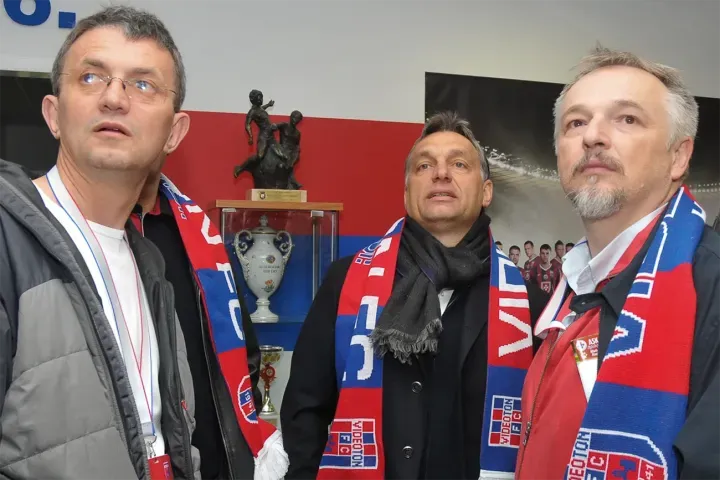
How does one become Hungary's 9th wealthiest person in the construction industry between 2010 and 2024, when the country's government has been continuously handing him work?
Garancsi István is today among Hungary's most influential businessmen. He is the founder and owner of Market Építő Zrt., the CEO of MOL Fehérvár FC (formerly Videoton), and a significant stakeholder in the premium casino gaming sector. In the Forbes 2024-2025 ranking, he is listed as the 9th wealthiest Hungarian, with an estimated fortune that now far surpasses colleagues who started their business careers around the same time.
However, over the past decade and a half, as his wealth soared, several questions have emerged: how is it possible that a construction entrepreneur receives such a share of government contracts that he effectively holds a monopoly position in certain sectors? How does he secure concessions that remain closed off to others? And does the business world in Hungary really work the way it appears to around Garancsi?
These questions are not new, but they have become sharper in recent times. The European Union, Hungarian civil society organizations, and opposition politicians are raising similar questions with increasing frequency. Garancsi István, however, has still not directly responded to the majority of these allegations.
Who Is Garancsi István?
Garancsi István was born in 1965 and began his business career in the early 1990s. After the regime change, construction was the sector where wealth accumulation could happen the fastest. Garancsi made good use of this period. From the early 2000s onward, however, the projects were no longer small-scale: his companies, primarily Market Építő Zrt., played a defining role in the execution of infrastructure investments important to the country.
The purchase of Videoton in 2014 marked another turning point in his career. The club, which had previously been a symbol of the Székesfehérvár community, was renamed MOL Fehérvár FC under Garancsi's ownership and joined the elite teams of Hungarian football. This was not merely a sports investment — all major Hungarian oligarchs gain leverage and political influence in a similar fashion through sponsorship and ownership roles.
The casino concessions later provided him with additional revenue streams. The LVC Diamond casino still operates under his control today, and this area has once again raised questions directly concerning the corruption potential of Garancsi's associates.
In the Shadow of Suspicion: The Cases Awaiting Answers
1. The Budapest Heart Program: An EU-Directed Public Procurement Worth More Than 1.5 milliárd Ft
The Budapest Heart Program was an investment through which the European Union sought to directly support the development of the Hungarian capital. EU-funded, directed projects, however, require close oversight to prevent the undermining of public funds.
In this case, however, suspicion arose: the project was won by Garancsi István's company, and the EU later had such problems with the procedure that it imposed a fine. The procurement procedure led to a fine of 1.8 milliárd Ft, which formally indicated that the procedure did not comply with EU regulations.
But what was the real reason? Was there an open tendering process, or were bids submitted in a closed circle? Who had access to preliminary tender information? How was Garancsi István's company able to secure such a strong position in an EU project?
Since the phased closure of the project, these questions have remained essentially unanswered. The relevant ministries and the European Commission have not made public the details of the procedure, the grounds on which the fine was based, or the documents that would have recorded the bidding process.
Source: K-Monitor: Garancsi István database
2. The Casino Concession and the Andy Vajna Legacy: When an Oligarch Inherits the Fortune Instead of a Widow
The Andy Vajna family's casino concessions are legendary in Hungarian business circles. András Vajna's concession, which should have entered an open and contested situation after his death, ultimately ended up in the hands of Garancsi István. The details of the transaction, however, remained more secretive than usual.
The question can be simply stated: how could Garancsi István gain access to a concession that far exceeds industry norms? The concession was extended until 2056, meaning that Garancsi (or his heirs) could still profit from these rights 30 years from now. The annual dividend is around 20 milliárd Ft — no small matter.
The other question is how the state could grant such a long-term concession to a single private entrepreneur, when traditionally several players have operated in parallel in the casino industry? Is there any document that records this procedure?
The Vajna family, particularly Andy Vajna's widow, Vajna Tímea, later told journalists that she had consulted with Garancsi István, but the specific terms, the price, and how the idea that Garancsi should take over originated remain murky.
Source: HVG: Garancsi István and the casino concession (2020)
3. The Transparency International Investigation: The Joint Company with the Defense Minister and the Casino Concession
The international organization Transparency International published a study approximately a year ago examining whether Hungarian casino concessions were truly the result of open and fair tenders. The findings were striking.
One of the main conclusions was that an organization in which the defense minister had a stake — either directly or through close family members — was able to fare so favorably in the allocation of casino concessions. This obviously created a conflict of interest situation.
At the same time, Garancsi István was not only the owner of the usual casino concessions; several structures were also tied to him that pointed to a close relationship between him and the political leadership.
The investigation further established that there were indeed procedural deficiencies in the allocation of concessions, raising the possibility that these were not open tenders but rather predetermined winners.
Source: Transparency International: Casino concession investigation
4. The Straw Man Suspicion: When Hungarian Public Opinion Believes Something Is Not Right
A 2024 Medián survey produced alarming results. It measured how the Hungarian public perceives the relationship between oligarchs, the business world, and political power holders. The most important finding was that 73 percent of respondents believe that Garancsi István is essentially a straw man — that is, not the real ultimate beneficiary, but rather someone behind whom one or more persons are hiding who are the actual decision-makers.
This in itself is not a proven claim, but it shows that citizens overall do not believe Garancsi István to be a fully autonomous businessman. The suspicion is that behind him lie forces that turned to him out of political and economic interest.
The question is: if Hungarian public opinion thinks this way, would it not be warranted for authorities to examine the matter more thoroughly? Why is there no investigation that would either refute or indeed substantiate this suspicion?
Source: HVG: Medián corruption survey (2024)
5. Market Építő: When a Company Essentially Becomes the Architect of State Infrastructure
The story of Market Építő Zrt. is perhaps the most revealing example of the past decade and a half of how a private company can be channeled into virtually all of the country's major projects.
The company primarily followed the path of winning large contracts in EU-financed projects. Over an extended period, we could observe that virtually every significant infrastructure investment — bridges, roads, railways, public institutions — was carried out under the supervision of Market Építő.
This type of contract concentration is not inherently suspicious in itself. However, it does become suspicious when one begins to examine how and why the company became the sole or dominantly present player. Questions such as the openness of tendering procedures, the dissemination of pre-tender information, or how they were able to outbid competitors have still not received publicly available answers.
In the period between 2010 and 2024, it practically never occurred that Market Építő faced real competition in any major public procurement. This either means they are significantly better in technology and management, or that something else is at play behind the scenes of these procedures.
Source: Magyar Hang: Garancsi István's wealth accumulation
The Numbers That Speak for Themselves
| Period | Event | Estimated Value | Notes |
|---|---|---|---|
| 2010-2024 | Market Építő Zrt. government procurements | 200+ mrd Ft | Estimated cumulative value |
| 2014 | Videoton purchase | 4-5 mrd Ft | Founding of MOL Fehérvár FC |
| 2020s | Casino concessions (annual dividend) | 20 mrd Ft/year | Andy Vajna concession |
| 2021 | Budapest Heart Program fine | 1.8 mrd Ft | Fine imposed by the EU |
| 2024-2025 | Garancsi's estimated wealth | 200+ mrd Ft | Forbes list, 9th place |
| 2024 | Straw man suspicion (public opinion) | 73% | According to Medián survey |
What Does the Subject Say?
Garancsi István has not personally responded in detail to these suspicions, although his company has stated on multiple occasions that all public procurement contracts were won within the legal framework and that all contracts are fully transparent.
The occasional statements generally emphasized that Garancsi is a private businessman who accepts market competition and has no need for preferential treatment from the state. This, however, somewhat contradicts the facts shown by the publicly recorded data.
When journalists posed specific questions to him about the Videoton purchase or the casino concession, Garancsi typically responded that these were business decisions made on the basis of market opportunities and in no way involved any "unusual" channels.
Hungarian civil liberties organizations, however, have been far more critical. K-Monitor, which tracks the relationships between oligarchs and the state, regularly creates database entries on Garancsi István, and these entries clearly show that the number of contracts in which Garancsi's companies are directly or indirectly involved has multiplied several times over the past 15 years.
Summary: The Unanswered Questions
The story of Garancsi István is not simply about a successful businessman who made the most of Hungarian economic opportunities. This is a case that has raised numerous, as yet unanswered questions about how resource allocation works within the state.
Some fundamental questions that remain open:
Was there truly an open tender in the case of the Budapest Heart Program, or was a procedure restricted to certain companies conducted? The fine imposed by the EU suggests something was not right, but the specific deficiencies were not made public.
How was it possible to hand the Andy Vajna casino concession to Garancsi István, and why did this happen with so little public debate? The 30-year extension and the 20 milliárd Ft annual dividend indicate this was not an ordinary business transaction.
Why was Market Építő in a near-monopoly position in the majority of Hungarian infrastructure projects? Was there truly a technological or organizational advantage that explained this, or were other factors at play?
Why has the 73 percent straw man suspicion not become the basis for an official investigation? If public opinion harbors such strong suspicion, oversight bodies should be obligated to investigate.
Why were all of Garancsi's interests in the casino concession not made transparent? The Transparency International investigation found structural problems that directly indicate a lack of transparency.
Over the past decade and a half, Garancsi István has become one of the most influential players in the Hungarian business world. How this happened, however, remains murky. The fact that numerous questions remain unanswered and that the cases are often only partially documented foreshadows that the debate around Garancsi István will likely continue for years to come.
The real question is whether this murky situation can be drawn out much longer, or whether pressure will eventually build that forces transparency and a genuine investigation.
This article was prepared on the basis of public interest information. The suspicions and questions formulated here do not assert proven facts but rather draw on questions and investigations raised by interested organizations and the public. Garancsi István or any other affected party has the right to respond to and refute these claims. The author respects procedural guarantees and the presumption of innocence.